초록
This paper introduces a nonlinear string sound synthesizer, based on a finite difference simulation of the dynamic behavior of strings under various excitations. The presented synthesizer features a versatile string simulation engine capable of stochastic parameterization, encompassing fundamental frequency modulation, stiffness, tension, frequency-dependent loss, and excitation control. This open-source physical model simulator not only benefits the audio signal processing community but also contributes to the burgeoning field of neural network-based audio synthesis by serving as a novel dataset construction tool. Implemented in PyTorch, this synthesizer offers flexibility, facilitating both CPU and GPU utilization, thereby enhancing its applicability as a simulator. GPU utilization expedites computation by parallelizing operations across spatial and batch dimensions, further enhancing its utility as a data generator.
String Sound Synthesizer on GPU-accelerated Finite Difference Scheme
초록
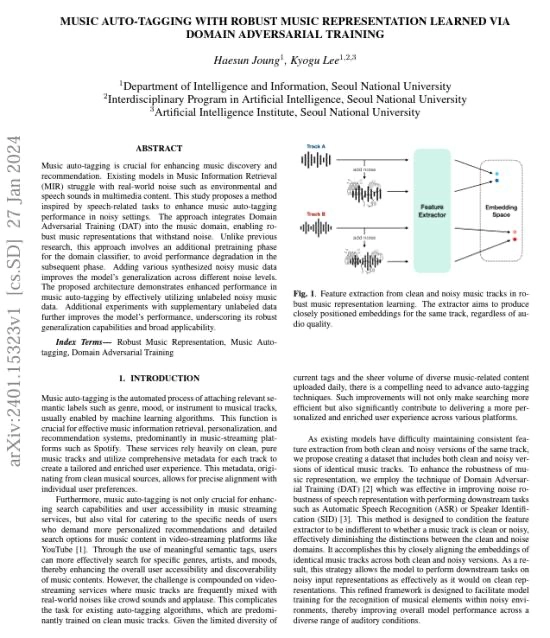
Music auto-tagging is essential for improving music discovery and recommendation. However, existing models in Music Information Retrieval (MIR) face challenges when confronted with real-world noise, such as environmental and speech sounds present in multimedia content. This study presents a novel method inspired by speech-related tasks to enhance music auto-tagging performance in noisy settings. The approach incorporates Domain Adversarial Training (DAT) into the music domain, resulting in robust music representations that can withstand noise interference. Unlike previous research, this approach includes an additional pretraining phase for the domain classifier to prevent performance degradation in subsequent phases. Moreover, the integration of various synthesized noisy music data enhances the model's generalization across different levels of noise. The proposed architecture exhibits superior performance in music auto-tagging by effectively leveraging unlabeled noisy music data. Furthermore, additional experiments with supplementary unlabeled data further enhance the model's performance, highlighting its robust generalization capabilities and broad applicability.
Music Auto-Tagging with Robust Music Representation Learned via Domain Adversarial Training
초록
이 연구의 목적은 금속 3D프린터가 금속공예나 주얼리 분야에서 활용되기 위해 각 용도에 맞는 공정 조건을 도출하는 것이다. 분말적층용융(PBF) 방식의 금속 3D 프린팅 방법 중 하나인 선택적 레이저 용융(SLM) 공정은 금속분말을 레이저로 용융시킨 후 다시 굳히는 과정을 반복하며 적층 시키는 제조 방식으로서 정교하고 복잡한 형상을 가진 제품을 만들 수 있는 장점을 지닌다. 그러나 적층 과정 내 발생하는 급격한 가열 및 냉각은 공극 형성 및 미세구조 변화를 야기하는데, 이는 난발과 같은 부분 의 강도 및 내구성을 저하시키는 주요한 원인이 될 수 있다. 연구방법은 스테인리스강 SUS316L 분 말을 이용하여 다양한 레이저 출력과 주사 속도를 조절해 에너지밀도를 변화시켜 바뀐 값에 따른 상 대밀도값을 도출하는 방식으로 진행되었다. 이후 경도 및 인장시험을 통해 강도와 연성을 확인하였으 며, 이를 통해 주얼리 작업에 최적화된 강도와 연성을 갖는 공정조건을 수립하였다. 연구결과 주조의 어려움으로 그동안 스테인리스를 사용한 주얼리는 디자인에 제한이 많았으나 PBF방식의 장점을 활용 하여 서포트 없이 트러스들이 중공 구조를 이루어 기존의 정밀주조로는 제작이 어려운 주얼리 형상을 SLM공정으로 출력할 수 있었다. 파우더기반인 SLM출력방식의 특성상 광택이 없는 출력물의 표면은 스레인리스 합금으로 경도가 높았으나 주얼리의 폴리싱도구를 통해 표면처리가 가능하였고 도출된 공 정 조건을 통해 제작된 난발로 큐빅 지르코니아와 같이 경도가 높지 않은 스톤도 기존의 세공 도구를 사용하여 세팅할 수 있음을 확인하였다.
Research on Process Conditions for SLM (Selective Laser Melting) Stainless Steel (SUS316L) 3D Printing through Hollow Structure Jewelry Production

초록·키워드
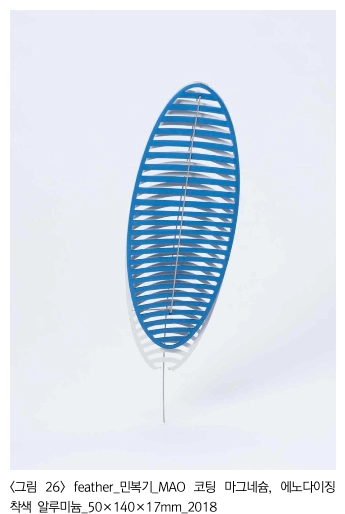
본 연구에서는 제한된 분야에 사용되고 있는 경량금속인 마그네슘합금의 감성소재로서의 가능성에 주목하여, 마그네슘합금을 미술재료로 활용하기 위한 다양한 제작기법을 연구하고, 이를 기반으로 조각과 금속공예작품을제작하여 마그네슘 소재가 새로운 산업분야로 확장될 수 있는 가능성을 고찰한다. 마그네슘합금의 성형 특성과 부식 특성에 대해 조사하였고, 톱질, 레이저 커팅, 관통부식에 의한 투각과 절삭, 절곡, 상온에서의 망치성형과 유압프레스, 스피닝 성형, 다양한 대체주형소재를 활용한 중력주조, 용접, MAO (플라즈마 전해산화) 등, 다양한 금속공예기술 및 현대 산업기술을 마그네슘합금 소재에 적용해보고 적합성 여부를 논의하였다. 이어진 시작품 제작 연구에서는 MAO 표면처리에 의한 밝은 백색의 표면을 타 금속 소재에서 얻을 수 없었던새로운 색감으로 인지하고 활용한 장신구, 견고하고 운반성이 좋은 의자, 부피가 크면서도 가벼운 천장 조명, 마그네슘 소재의 특성에 작가의 고유한 철학을 담아 새롭게 표현한 조소작품을 제작하였으며 이 과정에서 공예및 미술 소재로서의 마그네슘의 한계와 이를 극복할 수 있는 창의적인 방안을 모색하였다.
This research focuses on the possibility of light weight metal, Magnesium alloy, which is used in limited fields, as a sensitivity subject matter. Magnesium alloy has been studied with diverse manufacturing techniques to be used as a art material. Moreover, based on this, by making sculpture pieces and metal artworks, possibilities of expanding to new industries can be considered. Forming property and corrosion characteristics of magnesium alloy were researched, then suitability of Magnesium alloy was determined by applying various metal work techniques as well as modern industrial techniques; such as sawing, laser cutting, etching for openwork, cutting, bending, hammering, hydraulic press and spinning in room temperature and, gravity casting using various substitute cast materials, welding, MAO(Micro-arc oxidation) etc. Subsequently, trial works range from application in jewelry that recognizes the bright white surface from MAO surface treatment, that are unobtainable in other metal materials, as well as sturdy and easily movable chairs, voluminous yet light ceiling lightings, innovative sculpture piece made from the artist’s philosophy with the characteristics of Magnesium. In the study, Magnesium’s limit as a craft and art material was challenged and overcome by searching for creative measures.
미술재료로서의 마그네슘합금 활용 연구

초록
본 연구의 목적은 응용수학분야에서 연구되어 토목, 건축 등의 분야에서 활용되고 있는 유한요소해석에 대해 살펴보고, 이를 장신구 분야에 적용할 가능성을 탐색하는 데 있다. 유한요소법(Finite Element Method; FEM)은미분방정식 문제를 다른 형태로 바꾸고 이 해(解)를 어떤 함수의 일차결합으로 나타내는 수치적인 근사해법(approximation method)의 하나이다. 이러한 수학적 원리를 바탕으로 재료역학 등의 공학분야에서 물성과 하중 등 외부적 요인을 설정하고 대상물의 물리적 변위의 근사값을 도출하여 구조를 해석하는 것이 유한요소해석(Finite Element Analysis; FEA)이다. FEA는 컴퓨터의 계산을 통한 시뮬레이션 기술로 빠르게 정립되었고, 이후 CAD의 모델링데이터를 활용할 수 있도록 통합되어 강도, 열, 유동, 진동 등 다양한 물리적 환경의 시뮬레이션을 통해 효율적 설계를 도출하는데 활용되고 있다. 장신구는 매우 작은 사물이지만 신체 위에 착용되는 필연적 조건을 가지므로 안정적 구조로 제작되어야 하지만 이를 위해 FEA를 활용한 사례는 없었다. 연구자는 이러한 장신구의 요구조건을 충족하는 새로운 난발(Prong)의 구조연구를 위해 FEA를 활용한 난발구조를 연구하였고 4개 혹은 6개로 이루어진 일반적인 난발구조에서 난발의 개수를 최소화하여 2개의 난발구조를 가지도록 하였다, 그리고 빛의 유입을 위해 오브제를 기저부에서 2mm 위로 띄워 고정할 수 있는 난발구조를 개발하였다. 이러한 사례에서와 같이 FEA는 주얼리의 구조안정성 검증 뿐 아니라 새로운 컨셉의 디자인탐색에 도움을 줄 수있고 주얼리산업의 생산과정에서도 열과 유동의 해석을 통해 주조생산성과 품질을 개선시킬 수 있다. 또한 금속공예의 대공분야에서도 하중이나 낙하, 바람 등 다양한 물리적 외력을 시뮬레이션 하여 좀 더 안정적인 구조를도출하는데 활용될 수 있을 것이다.
The purpose of this study is to examine the Finite Element Analysis, studied in Applied Mathematics and used in the fields of Civil Engineering and Architecture, and to explore the possibilities of applying it to the field of jewelry. Finite Element Method changes differential equations into different forms and appears as one of the numerical approximation methods. With this mathematical principle background, the linear combination of the certain function’s value sets the external factors such as property and weight in the engineering field, material mechanics and Finite Element Analysis is the evaluation of the structure by approximating the physical displacement of the object. FEA quickly became a computerized simulation technology, and later integrated to utilize CAD modeling data to simulate various physical environments such as strength, heat, flow, and vibration, etc. for effective design. A jewelry is a very small object it has an inevitable condition to be worn on top of the body; therefore, needs to be made with a secure structure but, there has been no case for it with FEA. This research studies the required conditions of this kind of jewelry with new prong structure research that uses FEA and minimizes the number of prongs in the prongs’ structure to two from four or six, and developed new prong structures for the object to float 2mm above the basis for light to pass. In such a case, FEA not only verifies the structural stability but make new concept design exploration possible and can improve productivity and quality through the interpretation of heat and flow in the casting process of the jewelry industry’s production process. Moreover, various physical external forces such as weight, fall or wind can be simulated to construct safer structures for vessel making in the field of Metal Craft as well.
유한요소해석을 활용한 장신구디자인 사례연구 - 예술장신구 사례를 중심으로


초록
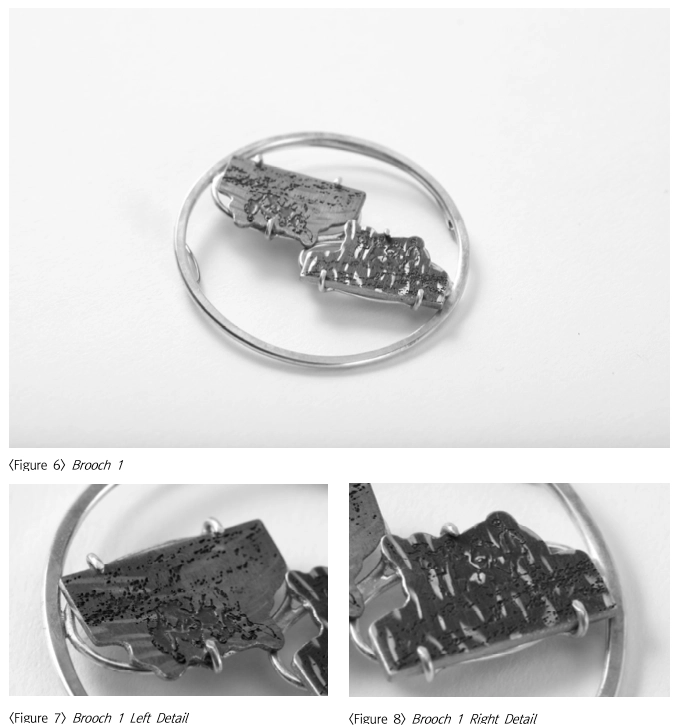
금속 공예가들은 금속의 색상표현을 위해 다양한 착색기법을 연구해 왔다. 많은 착색 방법들 가운데애노다이징 기법을 이용한 알루미늄 착색은 간섭색을 이용한 착색이나 넓은 판재의 애노다이징에는고가의 장비와 다공성 표면에 유해한 염료 투입후 봉공처리가 필요한 공정상의 제한이 있었다. 이에연구자는 내마모성이 뛰어나고 두께에 따라 다양한 간섭색을 나타내는 diamond-like carbon(DLC) 박막에 주목하였다. 이 연구의 목적은 두께에 따라 비철금속인 백동과 적동 기판에 충분한 접합성과간섭색이 나는지 확인하기 위함이다. 연구 방법은 백동과 적동 판재를 이용하여 네 가지의 도형을 조합한 패턴을 부식시켜 준비하고 공정시간을 달리하여 네 가지의 두께로 DLC 박막을 코팅하였다. 각조건에서의 두께와 색상을 주사전자현미경, 색 분석기를 이용하여 확인하고. DLC 박막의 반사모드만을 고려한 모델로 간섭색을 예측해보았다. DLC 코팅 후 코팅된 금속 시편을 10개의 색상 팔레트로 사용해 색을 조합하여 두 개의 브로치를 제작하였고 직경 25cm로 성형된 기물에 보라색 DLC 코팅을적용해 제작 가능성을 확인 하였다. 브로치의 제안에서는 코팅한 표면 위를 일부 연마해 본래의 금속색과 코팅된 색의 차이를 대비시켜 연출하여 생동감 있는 표현과 DLC 코팅을 연마용 버로 일부 제거하고 바탕 금속이 부분 노출되게 하여 입사법과 비슷한 색상의 대비효과를 얻을 수 있었다. 또한 이연구를 통해 큰 직경의 기물에서는 그동안 표현되기 어려웠던 남보라 계열의 색상 표현과 반복된 마스킹 작업 없이 높이에 따른 간섭색의 그라데이션을 통해 풍부한 색상 표현이 가능하였다.
Metalsmiths have studied various surface treatments for the color expression of metals. Among many coloring methods, aluminum anodizing coloring technique employing interference color had limitations in which it requires costly equipment for applying on a wide metal plate, and not ecologically friendly sealing treatment after injecting harmful dyes on the porous surface. Therefore, the researchers paid attention to the diamond-like carbon(DLC) film that showed excellent wear resistance and various interference colors depending on the thickness. This research also investigated whether sufficient adhesion and interference color were achieved depending on the thickness by using nonferrous metals, nickel and copper plates. Four different pattern images using figures were etched on nickel and copper sheets and nano-thin DLC films were coated with four different thicknesses by varying the coating process time. It showed thicknesses and colors under each condition by using a scanning electron microscopy and a colorimetry and predicted the interference color with a model that considered only the reflection mode of the DLC film. After the DLC coating, two brooches were made by combining the coated metal specimens from 10 color palettes, and navy-purplish DLC coating was applied to a formed object with a diameter of 25cm to confirm the possibility of feasible manufacturing. In the brooch’s proposal, some of the coated surfaces were taken off to enhance the vivid contrast between the original metal color and the coated color. Furthermore, by removing some of the DLC coating films with a polishing burr and partially exposing the background, it was possible to obtain a color contrast effect similar to the inlay ‘Ipsa’ technique. With the large-diameter object, it was possible to express the colors of the navy purple series, which had been difficult to express so far. Moreover, without repeated masking processes, diverse color expressions were available through the gradation of interference colors according to the height of the object during the DLC coating.
금속공예에서 DLC 코팅을 활용한 색상 표현 연구 - 백동과 적동 바탕 금속을 중심으로

Abstract
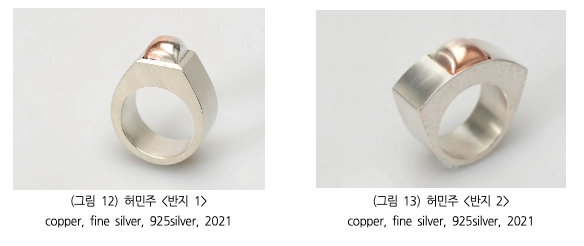
Methods that have the potential to express gradients of color in metal crafts include surface coloring, anodizing, plural casting, and diffusion bonding of heterogeneous metals. However, traditional methods are time-consuming and costly, and there is a limit to expressing natural phase of colors. In this research, silver and copper powders were used to stack each powder in a cylindrical mold with a mixing ratio of seven steps. Then a solid green body with natural color gradients was made only under pressure at room temperature without additional heating. The pressure-only green body was possible to shape by basic metal craft techniques such as cutting and polishing. It has been processed into several forms in the design of a new ring to reveal gradients and used in such a way that it is set in the ring's bezel structure instead of gem.
금속공예에서 색의 그라디언트를 표현하기 위한 가능성을 지닌 방법에는 표면착색, 아노다이징, 다원주조, 이종금속의 확산접합 등이 있다. 하지만 기존의 방법들은 시간과 비용이 크게 소요되며 자연스러운 색의 단계를 표현하기에는 한계가 있었다. 본 연구에서는 은과 구리의 분말형태를 사 용하여 각 분말의 혼합비율을 7단계로 변화시키면서 원통형 금형 안에 적층하고, 추가적인 가열 없이 상온에서 압력만을 가하여 자연스러운 그라디언트를 갖는 견고한 성형체를 얻었다. 압력만으 로 제작된 성형체는 절삭과 연마 같은 금속공예의 기본기법으로 성형이 가능하였으며, 그라디언트 를 드러내기 위한 새로운 반지 디자인에 여러 형태로 가공되어 보석 대신 반지의 난집 구조에 세 팅되는 방식으로 활용되었다.
금속분말을 활용한 색의 그라디언트 표현
초록
본 연구는 주얼리산업에 활용할 환경영향성평가의 방식과 탄소저감 전략을 제안하는 것을 목적으로한다. 이를 위해 환경영향성평가의 적용과 연구가 활발한 철강산업의 사례를 분석하고, 주얼리산업에적용할 전략을 제시한다. 각각의 과정에서 철강산업과 주얼리 분야 전문가를 인터뷰하는 질적 연구방법으로 현실성을 검증한다. 세계적으로 통용되고 있는 현행의 환경평가제도는 ISO의 TypeⅠ,Ⅱ,Ⅲ으로 분류한 환경라벨링 분류체계가 있고, 한국환경산업기술원도 이에 따른 EPD인증을 시행하고 있다. 철강산업 연구원의 인터뷰에서는 환경인증 획득의 여러 난점을 소개하고, 철강산업의 탄소저감 전략을 수록하여 주얼리산업에 응용할 아이디어로 연계한다. 철강과 건축산업의 정량적 환경영향평가는BSRIA 등의 신뢰도 높은 데이터베이스를 바탕으로 이루어진다. 소품종 대량생산을 유지하는 철강산업의 전략을 수평적으로 적용할 수는 없지만, 귀금속과 천연석 및 합성석에 대한 원산지 및 가공 수송방식별 환경영향성 데이터베이스 구축이 필수적 요소라는 점을 시사한다. 연구자의 탄소저감 아이디어가 주얼리 산업에 적용 가능한지 검증하기 위해 주얼리 브랜드 B사의 디자인팀 이사와 인터뷰를 실시하였다. 친환경적 전환을 최우선 과제로 여기지 않는 주얼리산업에 적용할 라벨링 분류체계는 Type Ⅱ의 ‘환경성자기주장제도’가 적합하다. 또 현재의 EPD인증에서 사용하는 7가지 영향범주 중 자원, 탄소, 물 발자국의 3가지 범주만 선별하여 전과정평가를 향한 첫 출발을 제언하고, 향후 데이터베이스와사용자 인식이 성숙 단계에 접어들었을 때 EPD인증 시행에 쉽게 적응하는 것을 목표한다.
The purpose of this study is to propose an environmental impact assessment method and a carbon reduction strategy to be used in the jewelry industry. To this end, the application of environmental impact assessment and research of the active steel industry are analyzed, and strategies to be applied to the jewelry industry are proposed. In each process, the practicality is verified with a qualitative research method that interviews experts in the steel industry and jewelry fields. The current environmental evaluation system, which is widely used worldwide, has an environmental labeling classification system classified as Type I, II, and III of ISO, and the KEITI also conducts EPD certification in Korea. In an interview with the Steel Industry Research Institute, various difficulties in obtaining environmental certification are introduced, and carbon reduction strategies in the steel industry are included and linked to ideas to be applied to the jewelry industry. The quantitative environmental impact assessment of the steel and construction industries is based on reliable databases such as BSRIA. Although the steel industry’s strategy of maintaining mass production of small items cannot be applied horizontally, it suggests that the establishment of an environmental impact database by country of origin and processing transportation method for precious metals, natural stones and synthetic stones is an essential factor. An interview was conducted with the design team director of Jewelry Brand B to verify whether the researcher’s carbon reduction idea was applicable to the jewelry industry. Type II’s the ‘Self-declared environmental claim’ is suitable for the labeling classification system to be applied to the jewelry industry, which does not consider eco-friendly transformation a top priority. It also aims to select only three categories of resources, carbon, and water footprint among the seven impact categories used in current EPD certification, suggesting a first start for LCA, and easily adapt to EPD certification implementation when database and user awareness enter maturity.
주얼리산업에서의 환경영향성평가를 위한 예비 연구 - 환경인증 및 환경성자기주장제도를 중심으로
중공 구조 주얼리 제작을 통한 SLM방식 스테인리스(SUS316L) 3D 프린팅 공정 조건 연구

Abstract
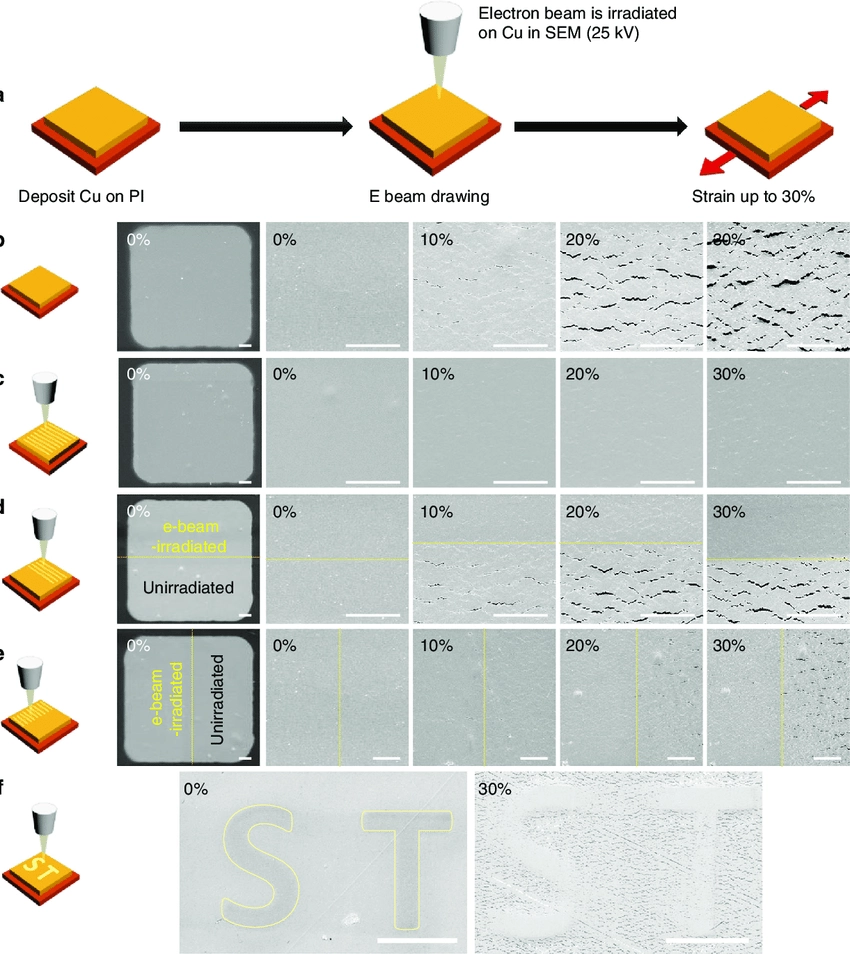
While cracks are usually considered detrimental, crack generation can be harnessed for various applications, for example in ceramic materials, via directing crack propagation and crack opening. Here, we find that electron beam irradiation prompts a crack suppression phenomenon in a copper (Cu) thin film on a polyimide substrate, allowing for the control of crack formation in terms of both location and shape. Under tensile strain, cracks form on the unirradiated region of the Cu film whereas cracks are prevented on the irradiated region. We attribute this to the enhancement of the adhesion at the Cu–polyimide interface by electrons transmitted through the Cu film. Finally, we selectively form conductive regions in a Cu film on a polyimide substrate under tension and fabricate a strain-responsive organic light-emitting device.
Selective crack suppression during deformation in metal films on polymer substrates using electron beam irradiation
Abstract
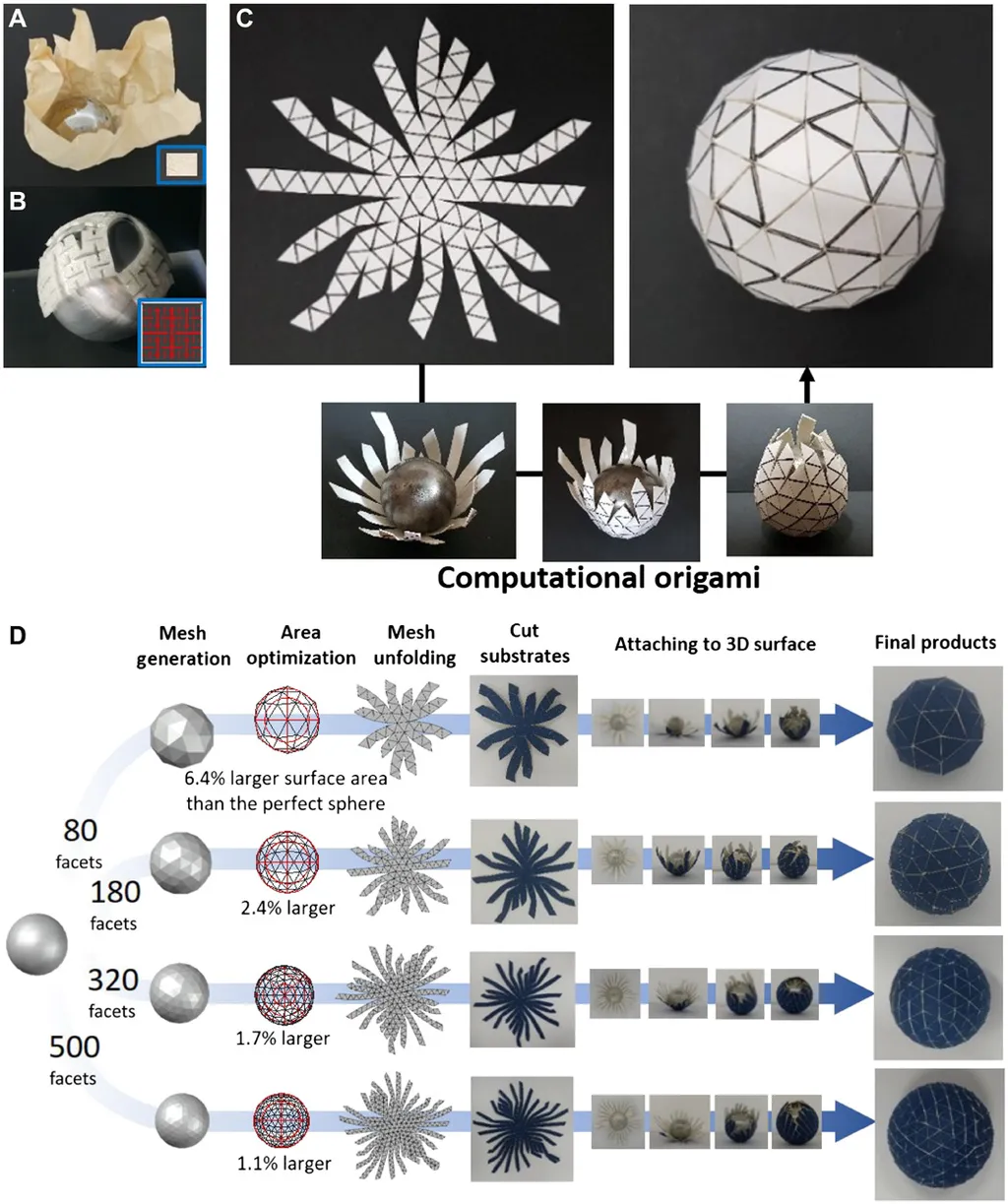
This study starts from the counterintuitive question of how we can render conventional stiff, nonstretchable, and even brittle materials sufficiently conformable to fully wrap curved surfaces, such as spheres, without failure. Here, we extend the geometrical design method of computational origami to wrapping. Our computational wrapping approach provides a robust and reliable method for fabricating conformal devices for arbitrary curved surfaces with a computationally designed nonpolyhedral developable net. This computer-aided design transforms two-dimensional (2D)–based materials, such as Si wafers and steel sheets, into various targeted conformal structures that can fully wrap desired 3D structures without fracture or severe plastic deformation. We further demonstrate that our computational wrapping approach enables a design platform that can transform conventional nonstretchable 2D-based devices, such as electroluminescent lighting and flexible batteries, into conformal 3D curved devices.
Computational wrapping: A universal method to wrap 3D-curved surfaces with nonstretchable materials for conformal devices
Abstract

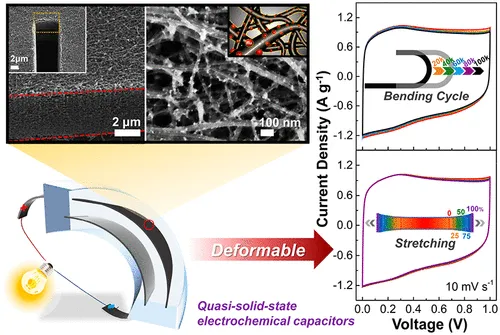
Despite the increase in demand for deformable electrochemical capacitors as a power source for wearable electronics, significant obstacles remain in developing these capacitors, including their manufacturing complexity and insufficient deformability. With recognition of these challenges, a facile strategy is proposed to fabricate large-scale, lightweight, and mechanically robust composite electrodes composed of ruthenium nanoparticles embedded in freestanding carbon nanotube (CNT)-based nanosheets (Ru@a-CNTs). Surface-modified CNT sheets with hierarchical porous structures can behave as an ideal platform to accommodate a large number of uniformly distributed Ru nanoparticles (Ru/CNT weight ratio of 5:1) while improving compatibility with aqueous electrolytes. Accordingly, Ru@a-CNTs offer a large electrochemically active area, showing a high specific capacitance (∼253.3 F g–1) and stability for over 2000 cycles. More importantly, the exceptional performance and mechanical durability of quasi-solid-state capacitors assembled with Ru@a-CNTs and a PVA-H3PO4 hydrogel electrolyte are successfully demonstrated in that 94% of the initial capacitance is retained after 100 000 cycles of bending deformation and a commercial smartwatch is charged by multiple cells. The feasible large-scale production and potential applicability shown in this study provide a simple and highly effective design strategy for a wide range of energy storage applications from small- to large-scale wearable electronics.
Large-Scale, Lightweight, and Robust Nanocomposites Based on Ruthenium-Decorated Carbon Nanosheets for Deformable Electrochemical Capacitors
Abstract
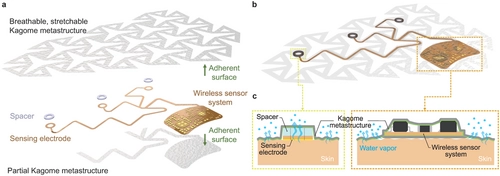
With increasingly diverse functionalities of electronic skins (E-skins), components and structures for the E-skin have also become more diverse and complex. It is extremely challenging to make all the components and devices required for additional functionalities stretchable and breathable to ensure skin comfort. Herein, we report a facile strategy to realize a versatile hybrid E-skin patch with great skin comfort by developing a breathable and stretchable metastructure to serve as the platform material of the hybrid E-skin patch. A Kagome-based mechanical metastructure made of breathable, stretchable medical adhesive integrates and tethers non-stretchable or stiff components and devices to the skin, allowing for both the breathability and mechanical comfort of skin. A wireless skin sensor system to sense electrocardiogram (ECG) signals and wirelessly transmit ECG signals in an event-driven manner such as sending R peaks only is developed on a polyimide-based flexible printed circuit board. The Kagome metastructure-tethered wireless ECG sensor patch does not cause significant skin discomfort when worn for five days, and successfully enables the event-driven wireless monitoring of ECG signals. We envision that this facile and versatile approach expands the type of materials and functionalities of E-skin for digital healthcare, personalized medicine, and smart prosthetics with emerging functionalities.
A Breathable and Stretchable Metastructure for a Versatile Hybrid Electronic Skin Patch with Long-Term Skin Comfort
Abstract
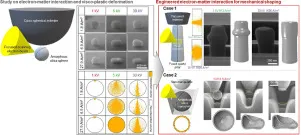
Amorphous silica deforms viscoplastically at elevated temperatures, which is common for brittle glasses. The key mechanism of viscoplastic deformation involves interatomic bond switching, which is thermally activated. Here, we precisely control the mechanical shaping of brittle amorphous silica at the nanoscale via engineered electron–matter interactions without heating. We observe a ductile plastic deformationof amorphous silica under a focused scanning electron beam with low acceleration voltages (few to tens of kilovolts) during in-situcompression studies, with unique dependence on the acceleration voltage and beam current. By simulating the electron–matter interaction, we show that the deformation of amorphous silica depends strongly on the volume where inelastic scattering occurs. The electron–matter interaction via e-beam irradiation alters the Si–O interatomic bonds, enabling the high-temperature deformation behavior of amorphous silica to occur athermally. Finally, by systematically controlling the electron–matter interaction volume, it is possible to mechanically shape the brittle amorphous silica on a small scale at room temperature to a level comparable to glass shaping at high temperatures. The findings can be extended to develop new fabrication processes for nano- and microscale brittle glasses.
Athermal glass work at the nanoscale: Engineered electron-beam-induced viscoplasticity for mechanical shaping of brittle amorphous silica
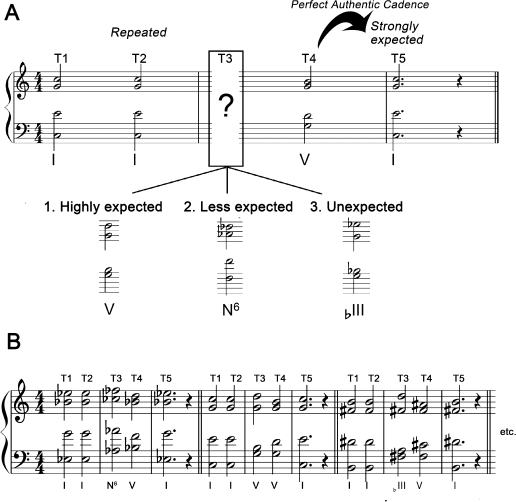
Abstract
The present study investigated the influence of musical expectations on auditory representations in musicians and non-musicians using magnetoencephalography (MEG). Neuroscientific studies have demonstrated that musical syntax is processed in the inferior frontal gyri, eliciting an early right anterior negativity (ERAN), and anatomical evidence has shown that interconnections occur between the frontal cortex and the belt and parabelt regions in the auditory cortex (AC). Therefore, we anticipated that musical expectations would mediate neural activities in the AC via an efferent pathway. To test this hypothesis, we measured the auditory-evoked fields (AEFs) of seven musicians and seven non-musicians while they were listening to a five-chord progression in which the expectancy of the third chord was manipulated (highly expected, less expected, and unexpected). The results revealed that highly expected chords elicited shorter N1m (negative AEF at approximately 100 ms) and P2m (positive AEF at approximately 200 ms) latencies and larger P2m amplitudes in the AC than less-expected and unexpected chords. The relations between P2m amplitudes/latencies and harmonic expectations were similar between the groups; however, musicians' results were more remarkable than those of non-musicians. These findings suggest that auditory cortical processing is enhanced by musical knowledge and long-term training in a top-down manner, which is reflected in shortened N1m and P2m latencies and enhanced P2m amplitudes in the AC.


Musical Expectations Enhance Auditory Cortical Processing in Musicians: A Magnetoencephalography Study
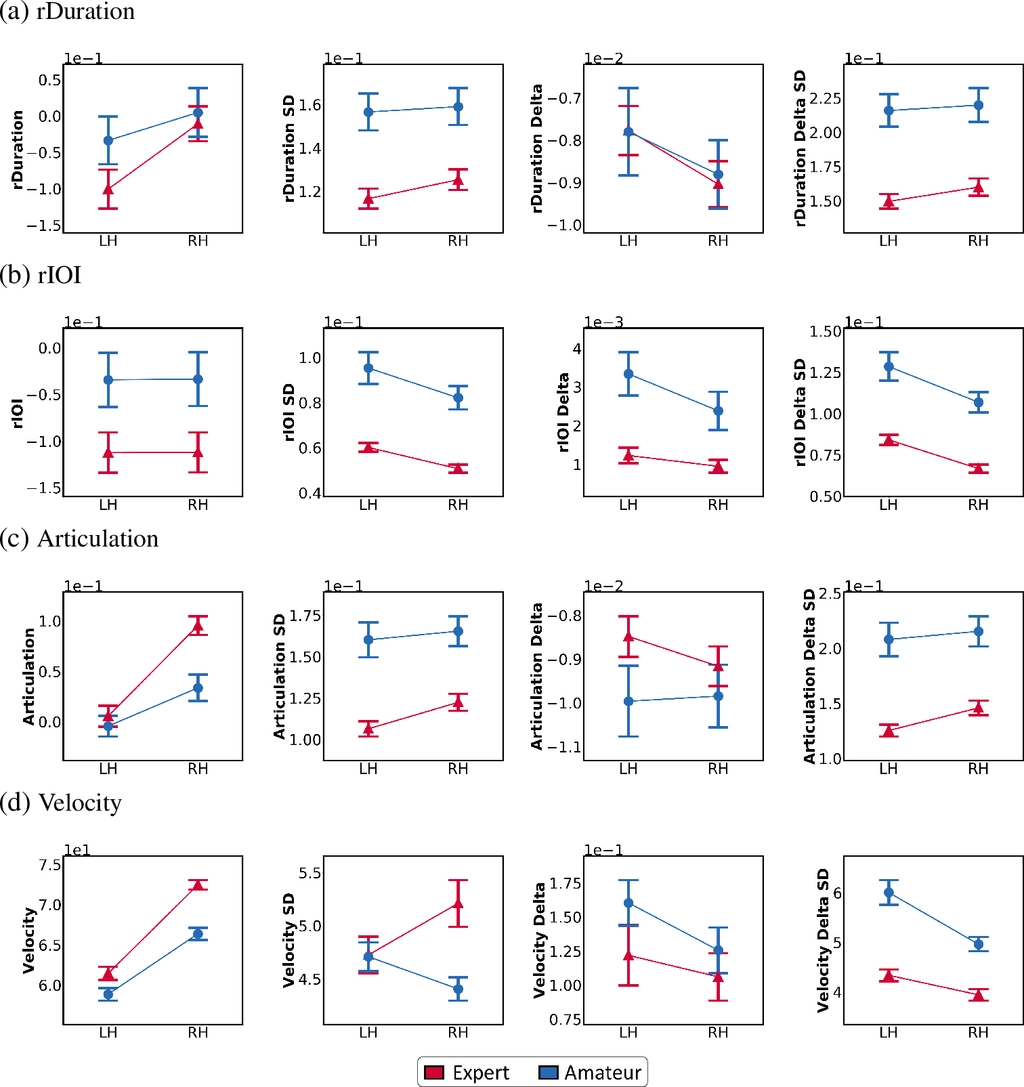

Abstract
Quantitative evaluation of piano performance is of interests in many fields, including music education and computational performance rendering. Previous studies utilized features extracted from audio or musical instrument digital interface (MIDI) files but did not address the difference between hands (DBH), which might be an important aspect of high-quality performance. Therefore, we investigated DBH as an important factor determining performance proficiency. To this end, 34 experts and 34 amateurs were recruited to play two excerpts on a Yamaha Disklavier. Each performance was recorded in MIDI, and handcrafted features were extracted separately for the right hand (RH) and left hand (LH). These were conventional MIDI features representing temporal and dynamic attributes of each note and computed as absolute values (e. g., MIDI velocity) or ratios between performance and corresponding scores (e. g., ratio of duration or inter-onset interval (IOI)). These note-based features were rearranged into additional features representing DBH by simple subtraction between features of both hands. Statistical analyses showed that DBH was more significant in experts than in amateurs across features. Regarding temporal features, experts pressed keys longer and faster with the RH than did amateurs. Regarding dynamic features, RH exhibited both greater values and a smoother change along melodic intonations in experts that in amateurs. Further experiments using principal component analysis (PCA) and support vector machine (SVM) verified that hand-difference features can successfully differentiate experts from amateurs according to performance proficiency. Moreover, existing note-based raw feature values (Basic features) and DBH features were tested repeatedly via 10-fold cross-validation, suggesting that adding DBH features to Basic features improved F1 scores to 93.6% (by 3.5%) over Basic features. Our results suggest that differently controlling both hands simultaneously is an important skill for pianists; therefore, DBH features should be considered in the quantitative evaluation of piano performance.
Quantitative Analysis of Piano Performance Proficiency Focusing on Difference between Hands
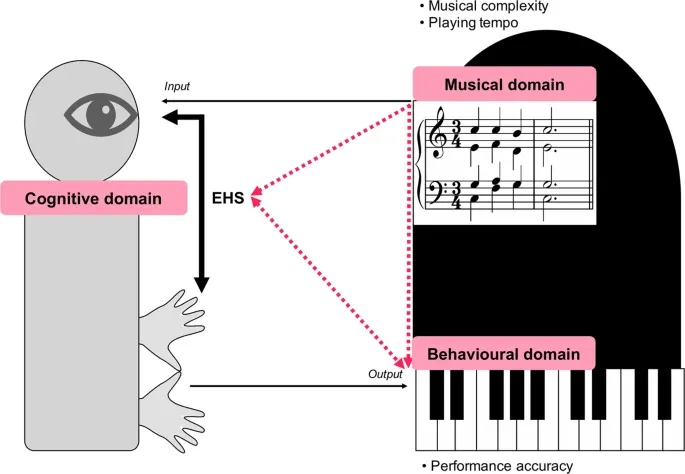
Abstract
Eye-hand span, i.e., the distance between a performer’s fixation and execution of a note, has been regarded as a decisive indicator of performers’ competence in sight-reading. However, integrated perspectives regarding the relationship between eye-hand span and sight-reading variables have been less discussed. The present study explored the process of sight-reading in terms of three domains and their interrelations. The domain indicators included musical complexity and playing tempo (musical domain), eye-hand span (cognitive domain), and performance accuracy (behavioural domain). Thirty professional pianists sight-read four musical pieces with two different complexities and playing tempi. We measured the participants’ eye-hand span, evaluated their performance accuracy, and divided the participants into three groups according to their performance accuracy values. Interestingly, we found that the eye-hand span did not change solely based on the performance accuracy. In contrast, the relationship between the eye-hand span and performance accuracy changed according to the difficulty of the sight-reading task. Our results demonstrate that the eye-hand span is not a decisive indicator of sight-reading proficiency but is a strategy that can vary according to the difficulty of sight-reading tasks. Thus, proficient sight-readers are performers who are skilled at adjusting their eye-hand span instead of always maintaining an extended span.
Eye-Hand Span is not an Indicator of but a Strategy for Proficient Sight-Reading in Piano performance
초록
21세기 학습자를 위한 학교음악교육에 관련된 문제들은 현대교육에서 중요한 문제로 간주되고 있다. 특히 ‘학습자 주도성’이라는 개념과 관련된 교실문화 형성은 교육적 관점에서 다차원적으로 연구 되고 있다. 학습자를 위한 내적, 외적 음악 문화 환경의 조성이라는 측면에서 볼 때 음악적 선호도에 대한 문제는 이러한 교육적 영역에 직접적으로 영향을 주고 밀접하게 연관된다. 이 연구의 목적은 첫째 음악 선호도를 규정지을 수 있는 주요 변인들 중 악곡이 지닌 복잡도와 음악 청각 발달의 결정적 시기에 있는 초등연령 학습자들의 음악 선호도와의 상관관계에서 나타나는 결과들을 분석하고, 둘째 분석결과를 바탕으로 21세기 변화된 사회-문화 환경 속에서 다양한 음악 장르에 노출되고 있는 한국의 초등학생들의 음악 선호도 경향에서 추정할 수 있는 주요한 교육적 의미들을 제시하는 것이다. 이를 위해 두 번의 실험이 실시되었고, 첫 번째는 95명, 두 번째는 344명의 초등학생들을 대상으로 하였다. 악곡의 복잡도는 섀넌(Shannon)의 엔트로피(entropy)를 사용하여 수치화하였다. 연구 결과 선호도에 영향을 미치는 요인은 복잡도, 친숙도, 음악훈련, 성별이 있었고, 복잡도 외에 선호도에 미칠 수 있는 여러 다른 요인들을 통제하여 분석한 결과, 악곡의 복잡도가 높을수록 초등학습자의 선호도가 낮아지는 것을 확인할 수 있었다. 이는 역 U형의 분트 곡선 중 복잡도가 높은 곡들에서 나타나는 현상이라 할 수 있다. 이러한 결과는 교육적인 측면에서 보았을 때 다양한 악곡들이 단지 교육용 악곡으로 교육과정에 투입되어야 할 뿐 아니라 학습자의 선호도에 미치는 요인들을 고려하여 교수학습방법론에 대한 다양화, 구체화를 필요로 한다는 것을 보여준다.
Abstract
Educational matters in school music education for the 21st century learner are regarded as one of the prominent issues in contemporary education. Specifically, how to generate the classroom culture that is relevant to the learner–agency concepts have been investigated from the multi-dimensional educational perspectives. Issues concerning music preference are paralleled with and can be directly influenced with concerned educational areas regarding how to provide the inner and external music-cultural contexts for the learner. The purposes of this study are the following: first, to analyze the relationship between the musical complexity and the preference of elementary school aged children who are in a critical period in the course of developing the aural perception and sensitivity. Second, major educational implications are suggested that have been drawn from the result of analysis, which shows the tendency of the music preference focused on the elementary school children in Korea who are exposed to diverse genres of music under the transformed 21st century societal-cultural environment. To achieve these purposes, two experimentations have been undertaken for the 95 and 344 subjects each. To quantify the level of musical complexity of each piece, Shannon’s entropy formula was used to obtain the objective reference of the framework. The results revealed that the factors determining the preference were musical complexity, familiarity, musical training, and gender. The researchers also confirmed that the higher the complexity goes, the lower the preference reduces having controlled other variables other than complexity, This phenomena could be seen to appear within the high complexity, musical pieces in accordance with the inverted-U shaped curve, The result reveals that not only the implementation of diverse genres of music into the school music curriculum but also more specified and an effective instructional methodology should be provided considering the critical factors of musical preference formation of the learner.
악곡의 복잡도와 한국 초등학생들의 음악선호도의 상관연구
초록
본 연구의 목적은 음악적 말하기 자극(Musical Speech Stimulation; MUSTIM)을 사용한 음악치료가 비유창성 실어증 환자들의 문장 구사력에 미치는 효과를 알아보기 위함이다. MUSTIM은 익숙한 노래를 사용하여 반사적 발화를 이끌어 내는 음악치료 기법으로, 본 연구에서는 비유창성 실어증 환자의 언어 발화를 유도해 내는 것을 목표로 하였다. 이를 검증하기 위해 비유창성 실어증 환자 3명을 대상으로 주 2회, 40분씩 총 16회기에 걸쳐 개별적으로 MUSTIM을 사용한 음악치료를 진행하였다. 연구 결과, 음절수가 증가하여도 발화속도에서의 차이는 거의 없었으며, 문장에서의 발화성공률이 오히려 더 높게 나타났다는 결과는 MUSTIM이 문장의 완성을 효과적으로 도와주는 훈련방법으로 사용될 수 있음을 보여준다. 또한, 훈련 언어의 75% 이상이 일상 발화로 이어졌다는 결과는 MUSTIM이 발화에 도움을 줄 음악적 단서를 풍부하게 제공하여 뇌의 잔존영역을 활성화시키는 데 도움을 줄 것이며, 이는 언어 발화로의 전이를 용이하게 하는 실마리를 제공할 수 있음을 시사한다.
The purpose of this study was to investigate the effects of a musical speech stimulation (MUSTIM)-based therapy on the sentence fluency of non-fluent aphasics. To investigate, the study administered a session to each of the three non-fluent aphasic participants over a total of 16, 40-minute sessions twice per week. To measure speech fluency, the investigator collected acoustic data using the praat program. Analysis revealed that the number of accumulated syllables produced increased from an average of 7 in the first session to an average of 188 in the last session; success rate of speech with a mean of 84%. Additionally, reaction time decreased from a mean of 2.3476 seconds in the first session to 0.6983 seconds in the final session. Results also revealed that participants were able to speak more syllables at similar speeds leading researchers to believe that a MUSTIM can be useful for increasing sentence fluency of non-fluent aphasics.
음악적 말하기 자극(MUSTIM)을 사용한 음악치료가 비유창성 실어증 환자의 문장 구사력에 미치는 효과
초록
본 연구는 학교교육과정에서 초등 학습자가 배우고 경험하게 되는 노래들이 어떠한 정서들을내포하고 표현하는가를 음형 - 정서에 관한 대표적 이론인 마테존과 쿡의 음형패턴이론에 근거하여 분석, 고찰함으로써 현재 사용되는 초등학교 음악교과서 수록곡의 음악 - 정서 표현의 측면을살펴보았다. 음악이 다양한 정서를 내포하고 있고 음악적 정서에 관한 문제는 현대음악교육철학에서 중요하게 간주되고 있음에도 불구하고 음악과 정서의 구체적인 상관관계에 관한 연구, 특히감성적으로 민감하게 음악적 소리를 수용하는 초등학습자와 음악적 자극으로서 노래와 연관된음악 - 정서에 관한 연구는 극히 드물다고 할 수 있다. 본 논문에서는 마테존의 이론에서 나타나는 음악의 조성·리듬과 정서 표현의 관계를 살펴보았고, 쿡의 이론을 통해서는 음고패턴과 정서표현의 관계를 고찰하였다. 분석결과, 대다수의 초등학교 노래들은 가사가 담고 있는 밝고 기쁜정서들은 이들 음형이론에서 제시했던 관련 음패턴과 거의 일치하였다. 하지만 선율이 지닌 음악적 표현은 근본적으로 다양한 유형과 차원의 정서를 표현할 수 있다는 것을 전제로 할 때, 기쁨, 밝은 분위기, 충족감, 당당함, 희망, 평화로움 등으로 제한된 정서는 음악적 표현 또한 제한적으로 특정 범주에만 속하는 것으로 분류되어졌다. 따라서 학교사회라는 공동체 속에서 겪게 되는불안감, 연민, 슬픔, 자아, 공동체에 관한 정서에 관한 표현에 있어서 장조에 기반한 곡들이 대부분이고 상대적으로 단조 곡들이 나타낼 수 있는 정서들이 확연히 결여되어있는 것으로 나타났다. 결론적으로 교육적 관점에서 학교노래는 두 가지 측면에서 재인식되고 창출되어져야한다. 첫째는 보편적 음악 - 정서적 측면에서 시대와 문화권에 상관없이 모든 문화권의 초등학습자에게근원적으로 다루어지는 정서표현의 악곡들에서도 표현기법들의 다양성이 심도 있게 반영되어야한다. 둘째 현대 한국의 사회문화적 상황에서 시대적합성을 띠며 초등학습자가 동화, 공감할 수있는 이시대가 요구하는 정서들이 적극적으로 학교노래에 다루어져서 창출되어야 한다.
Examination of the emotional features of elementary school songs has been conducted, based on the representative music-figure theories of Mattheson and Cook. Music as sonic-patterns intrinsically embraces diverse emotional meaning and its affective representation can be perceived by the listener. This reciprocal relationship between the musical-emotional experience on how music can evoke emotion and its effects on the perceiver are regarded as important educational issue in contemporary music educational philosophy. In spite of considerable emphasis regarding emotional and affective aspects of the music experience not only theoretically but also practically, little research has been conducted to reveal the concrete relatedness on which specific emotion and feelings can be aroused and provoked by which specific musical factors. Elementary school learners are still developing their sensibility about music-sonic auditory stimulus. Thus, musical elements such as tonal keys and rhythm, and their relative emotional expressions in Mattheson’s theory, and pitch patterns and emotional expressions in Cooke’s theory have been taken into consideration to compare the musical appearance of different songs. The result shows that, the relationship between the melodies and emotions presented by lyrics in most of the school songs is consistent with the music-figure patterns which were elaborated by the two music aestheticians. However, in terms of musical elements used to express diverse emotional dimensions, most of the songs are based on major tonality, restricted rhythmic and pitch patterns and emotions. In conclusion, from an educational perspective, matters of expressing diverse musical idioms and universal commonality of humanity which can encompass emotions such as sympathy, sorrow, sadness, empathy towards the isolation, separation and weakness as parts of the whole entity should be considered. Second, the emotions which exists and are prevalent in every corner of the school and socio-cultural environment in the contemporary world should be reflected in the school songs to allow the students to assimilate their feelings and empathy.
마테존과 쿡의 음형이론의 관점에서 본 초등학교 노래의 정서함의에 관한 연구